 |
|
||
|

|

|
|||||||
| Reviews in English Reviews in English |
 |
|
|
Herramientas |
|
#1
 21/02/26, 11:15:00
|
||||
|
||||
 VTOMAN Jump 2200 Portable Power Station + 400W VS400 Solar Panel Review
VTOMAN Jump 2200 Portable Power Station + 400W VS400 Solar Panel Review  Today we are putting smartphones aside to talk about something that gives them life: energy. I bring you the analysis of a real "beast", the VTOMAN Jump 2200. It's not just a giant battery; it's a 2200W power station designed to give us total autonomy in a camper, in the garden, or during any power outage. In fact, it is the most powerful portable battery we have reviewed on the site. The interesting thing about this model is that it doesn't come alone, as we have tested it alongside its 400W solar panel. Is it truly the ultimate solution to forget about wall sockets? Let's find out.  The first impression when receiving the VTOMAN Jump 2200 is that we are looking at a serious piece of equipment. The box is voluminous and heavy. This is no surprise, as the net weight reaches 17.5 kg. On the front, we can clearly see its 1548Wh capacity and its 2200W power output.  If we take a look at the side, we find all the technical data we love. The use of LiFePO4 batteries stands out. These types of batteries ensure a much longer lifespan than conventional ones. We also see that the inverter is pure sine wave. This is vital for connecting sensitive equipment without fear of damaging it. The port summary is impressive. We have three AC outlets and several USB ports. Among them, the two USB-C ports with a delivery of up to 100W each stand out. It's plenty of power to charge demanding laptops at maximum speed. The charging input supports up to 400W in total, which fits perfectly with the solar panel we are going to test.  When opening the box, the first thing that catches the eye is a very nice detail: a sheet with brand stickers featuring an adventurous and very striking design. It's a touch that is appreciated and gives the product personality from the very first minute. Everything comes perfectly protected by dense foam that ensures the integrity of the station during transport. Just above, we find a black zippered case. This case is essential for storing the wall charger and the rest of the cables so they don't end up lost in the van or the garage.   The contents of the case are another strong point you encounter when unpacking the unit.  Let's look at each of the elements included.  The manual is very well explained and gives us the first steps to take care of the LiFePO4 battery health. It recommends doing a first full charge to 100% before starting to use it heavily.  Along with the main transformer, we find the cable for the car cigarette lighter socket. This accessory is vital if you plan to use the VTOMAN Jump 2200 in a van or on long trips because it allows you to recover energy while driving.  A USB cable is also included, which is always handy to have for any small device. Best of all, the case has plenty of room to store all of this without having to fight with the zipper every time you finish using it.  The wall charger is a substantial block that feels high-quality and has an LED indicator to know when it is receiving power. This adapter delivers a charging power of about 316W according to our tests. It's a reasonable size for the power it handles, and the cables are long enough so that we don't have to be glued to the wall socket.   Looking at the VTOMAN Jump 2200 closely, the first thing that stands out is its industrial and robust design that conveys a great sense of durability. The chassis is made of high-resistance plastic with a matte finish that seems to withstand daily wear and tear without scratching easily.  On the top, we find a very solid integrated carrying handle that features a striking orange detail for easier grip. Despite its weight of 17.5 kg, its compact dimensions of 360x270x280 mm make it relatively easy to place in any corner of our camper or trunk.  The front panel is the true command center and is organized very intuitively by output sections. In the center sits an LCD screen that gives us all the critical information, such as the remaining battery percentage and input or output power in real-time. To the left, we have the charging inputs and the DC section with a cigarette lighter socket and USB ports. To the right, we see the three pure sine wave AC outlets and specific ports for the vehicle jump-starting function and battery expansion. Each section has its own independent power button, allowing us to save energy by turning off what we are not using at the moment.  Finally, we cannot ignore the two rubber caps located to the right of the screen. The first protects the connector for the Jump Starter emergency start cable, which is a very useful exclusive function for vehicles. The second cap hides the expansion port that allows connecting external batteries to triple the total capacity of the equipment if our needs grow over time.   The AC section occupies the lower right side and offers three traditional Schuko outlets protected by a 2200W pure sine wave inverter. This is very serious power that allows connecting several appliances at once without fear of the system locking up.  The front of the VTOMAN Jump 2200 is the real command center, and everything is distributed with great logic to avoid confusion. In the upper left corner, we find the two DC charging inputs that support a range of 12V to 60V with a maximum of 400W in total. Right next to it are two USB-C ports that are a marvel for us because they deliver up to 100W each. This power allows feeding high-performance laptops directly without needing to use the original wall charger.  Looking down at the lower left part, we see the block dedicated to direct current, which has its own independent activation button. Here we have the classic 12V/10A cigarette lighter socket accompanied by two additional DC5521 connectors for more specific accessories. To its right is the USB-A port block where we have three standard 5V and 2.4A connections for common gadgets. It's a great detail that they have included a fourth USB-A port with Quick Charge technology, differentiated in blue, to charge compatible mobiles at higher speeds.  On the sides, you can see generous ventilation grilles that are essential to keep the equipment cool when we demand the maximum from its 2200W inverter.  A very practical detail is the powerful LED light located at the top, which includes several lighting modes for nighttime emergencies.  One detail we should not overlook is the construction of the unit's base. When turning it over, we find four generous non-slip rubber feet located at the corners. These supports are essential to guarantee total stability of the equipment on surfaces that are not entirely flat, such as the floor of a van or a camping table. Having a considerable weight of 17.5 kg, these rubbers prevent the station from sliding accidentally and also protect the surface where we place it from possible marks or scratches.  Overall, the station feels like a well-built professional tool where every port and button is logically placed to facilitate daily use. This entire exterior design is thought out to protect the LiFePO4 cells inside, which guarantee more than 3000 cycles of lifespan.  The first thing I did after unpacking the unit was to test its charging system to see how it behaves with the included wall adapter. When connected to house power, the system automatically detects the energy input, and the front screen activates to give us all the necessary information. In my tests, I have seen how the station reaches an input power of 315W very stably. This figure is quite good for a battery of this size and ensures we don't have to wait an eternity to have it ready.  The LCD screen is a great ally during this process because it shows at a glance the current charge percentage along with the estimated time to complete the cycle. For example, in one of the measurements when the battery was at 83%, the panel indicated that barely 0.9 hours remained to reach maximum capacity. The input watts remain constant on the front panel, showing that the external transformer is doing a good job of conversion.  This charging performance fits perfectly with the specifications we saw on the side of the box, which mention a maximum DC input of 400W. Although with the wall charger we fall slightly below that theoretical limit, the speed is more than sufficient for everyday use. Before continuing, let's take a brief video look at the appearance of the station. The perfect complement for this station is, without a doubt, its impressive 400W solar panel, which comes in a large cardboard box to ensure its protection during shipping. This is the VTOMAN VS400 model, a foldable unit that surprises with its good finish and how well-thought-out its design is for transport.  Once out of the box, we find a robust structure that folds over itself and features a very comfortable integrated carrying handle. At the back, a zippered pocket stands out where we can store all the necessary cabling so it doesn't hang loose or get lost.  Taking a look at the technical details printed on the handle itself, we see that this panel is capable of delivering a peak power of 400W with a working voltage of 43V and a current of 9.3A. These are very serious figures that guarantee a fast charge of the Jump 2200 even on days that are not perfectly sunny.  Connectivity is handled via classic MC4 connectors that are perfectly housed in a specific hollow of the handle to prevent them from getting hit or dirty. Using this standard is a big plus because it means the panel is universal, and we could use it with almost any other power station on the market if necessary.   When opening the back pocket of the solar panel, we find some of the best news for any "tinkering" lover.  VTOMAN has included an adapter cable that is a true Swiss Army knife of connectivity. This cable connects to the panel's standard MC4 terminals and splits into three different outputs to cover practically any need. We have the classic circular DC connector used by our Jump 2200, but it also includes an XT60 socket and an Anderson-type connector. The advantage of having this variety of connections in a single cable harness is huge because it doesn't force us to buy extra adapters. The XT60 connector is highly valued in the world of radio control and DIY electronics, while the Anderson is a very widespread standard in the caravan and camper sector. The entire set of cables feels high-quality with appropriate thicknesses to handle the 400W that the panel is capable of generating in optimal conditions. It's a detail that shows they have thought about universal compatibility and not just closing the ecosystem to their own products.  When the time comes to deploy the solar panel, you realize the real dimensions of this accessory. When opening the latches and starting to extend it, we see that it consists of four large sections that cover a considerable collection surface. The design is intended to be a quick and simple process, although due to its size, it is advisable to do it with some free space on the ground or on the roof of the van. The structure feels very firm, and the external materials have a finish that conveys peace of mind against possible scratches or intensive outdoor use.  Each section of the panel is joined by a very resistant technical fabric that allows it to be folded like an accordion so that when finished, it returns to its compact briefcase shape. It is impressive to see how that entire surface, capable of generating up to 400W of peak power, can be comfortably transported with one hand thanks to the integrated handle.  Once we have it fully extended on the ground, we just have to orient it correctly towards the sun to start seeing how energy flows towards our station.  A very well-resolved aspect in the design of this solar panel is the support system found at the back. It features fold-out legs that allow angling the cells directly towards the sun to maximize energy collection efficiency. These legs are held by a system of straps and velcro that allows for easy and stable angle adjustments according to the sun's position at each moment of the day. Thanks to this support, the panel can stand on its own without needing an external support point, which greatly facilitates its placement on any clear terrain during our getaways.   In addition to the support legs, the panel includes metal reinforcements on the edges known as grommets. These metal holes are extremely practical because they multiply the mounting options for this 400W accessory in different environments. Their primary function is to allow us to hang the panel securely using zip ties or ropes. This is ideal for installing it on a balcony at home or for fixing it vertically on the side of a van if we don't have space on the ground. It's a very clever design detail that adds extra versatility to the set and allows us to take advantage of solar energy in almost any imaginable situation.  Deploying the solar panel outdoors is a truly simple process. For this test, we have placed it in a clear garden area, taking advantage of the system's ability to stand firm on its own. 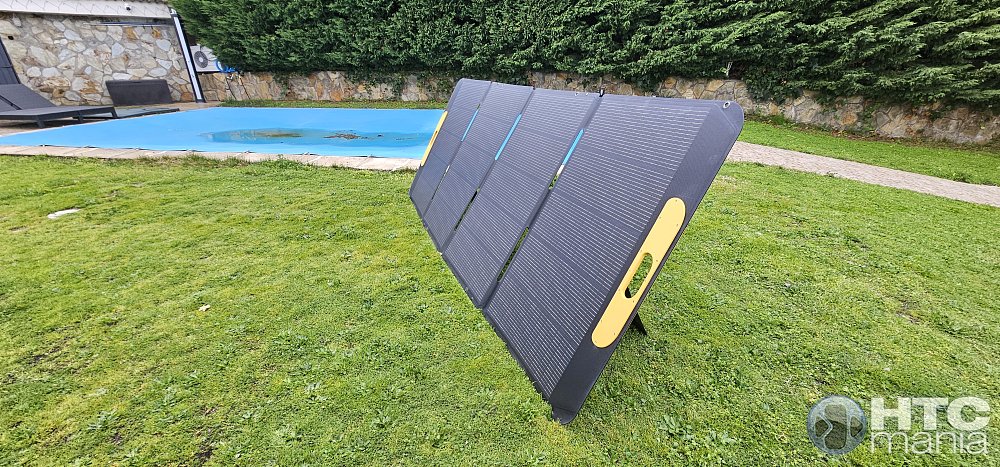 As we have seen, at the back, each panel has its own fold-out support that is adjusted by straps to achieve the ideal tilt towards the sky. These support legs are quite wide and are made of the same resistant material as the panel body, ensuring they don't accidentally close with a bit of wind. 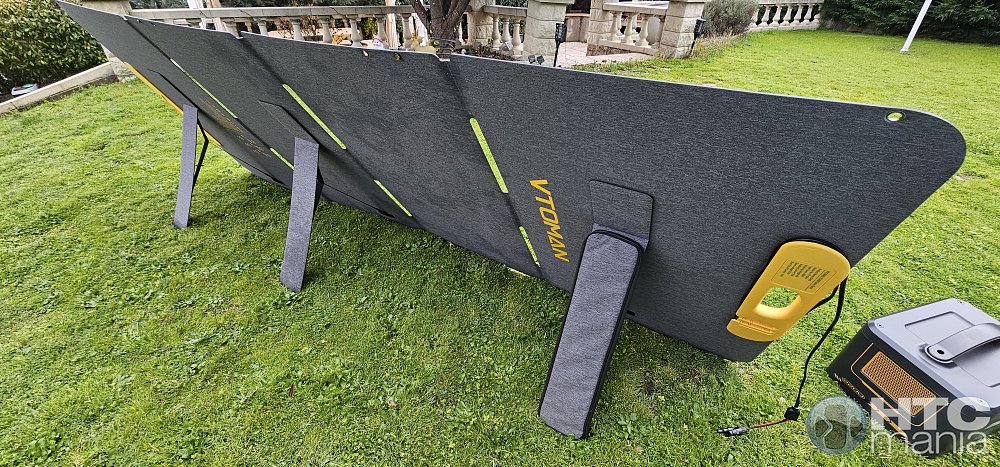 The connection between the solar panel and the station is an extremely simple process that requires no tools. The first thing we must do is use the cable harness we saw earlier. This cable acts as a bridge and features standard MC4 connectors at one end that we must join to the cables coming directly from the solar cells. It's a very secure click-type connection that guarantees no accidental disconnections while the battery is charging outside.  Once the panel cables are joined to the adapter, we just have to take the other end to the front of the power station. From the three tips available in the bundle of cables, we choose the circular one that fits perfectly into either of the two input sockets located at the top left. There is no possibility of error because the connector is designed to enter only one way, and the station detects the incoming current automatically. It's a joy to see how in a matter of seconds the entire system is configured and ready to start capturing free energy from the sun. 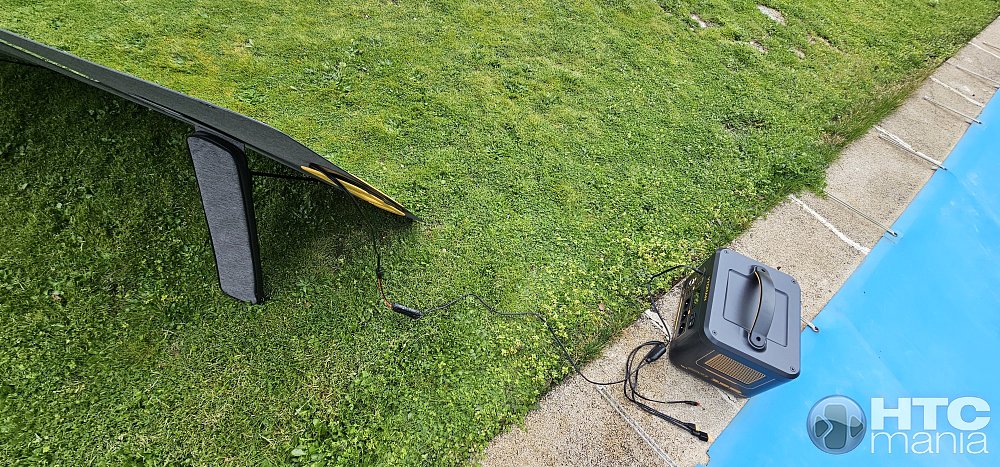 The most interesting thing about this test is that, initially, the day was quite cloudy, and conditions were not ideal for a solar panel. Despite that diffuse light and the lack of direct sun, the VTOMAN screen already marked a constant input of 51W. This figure is very respectable given the weather circumstances and gives us an idea of the high efficiency of the cells in this 400W panel. Having that power coming in only with ambient light ensures that on a clear day, the charge will be truly fast and efficient. 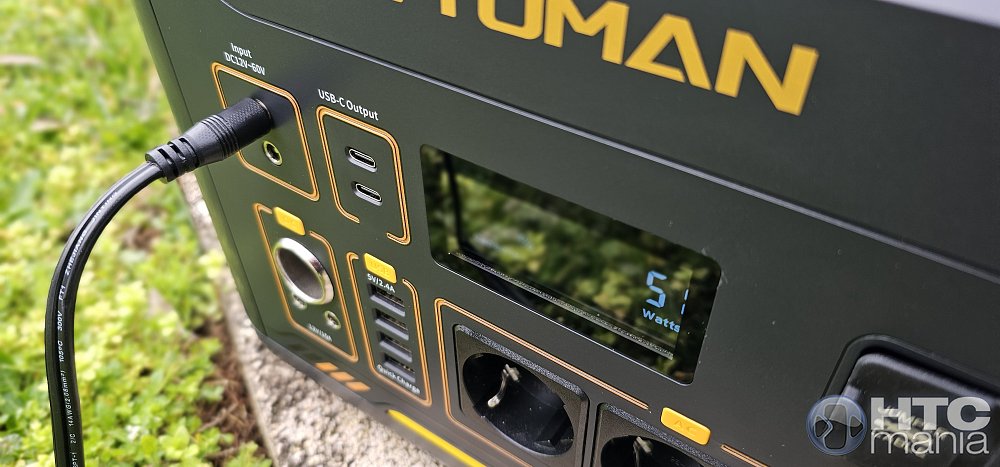 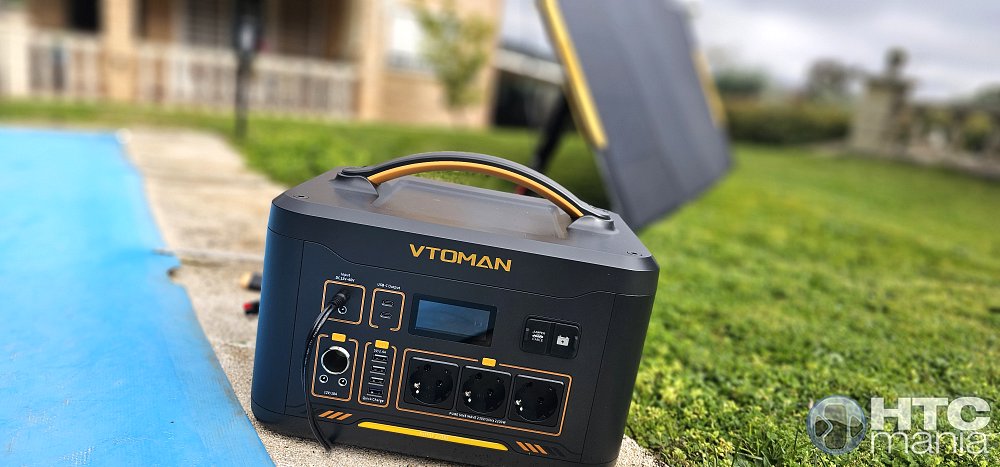 As soon as the sun started to peek through the clouds, the charging power took a spectacular jump from those initial 50 watts. We quickly moved to see figures of 220W, and in moments of greatest clarity, the screen reached the 400W maximum allowed input. This means that on a clear summer day, you could charge the station's 1548Wh in just over four hours of direct sun. It's an excellent solar recharge speed that allows you to use powerful appliances during the day and have the battery full again to face the night without worries. 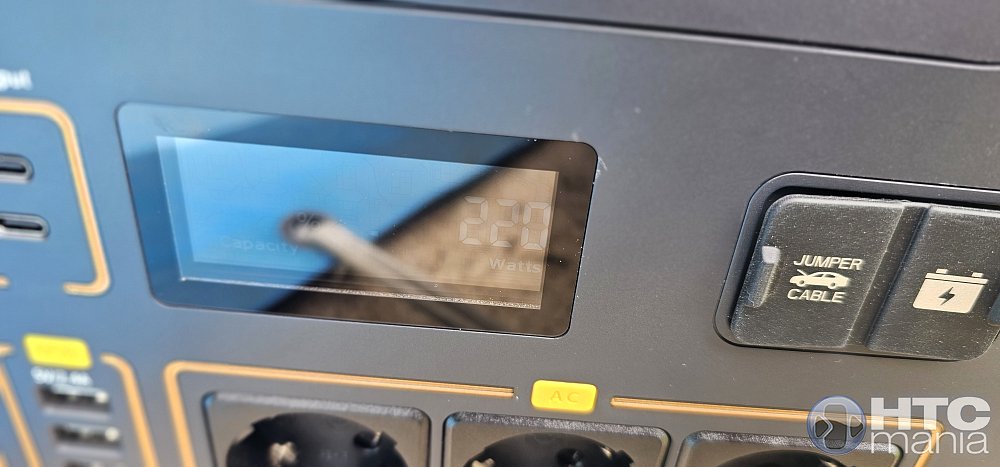 In the photos, you can see in the background my usual rigid panels that I've been using for some time and which have a power of 450W each. The difference in concept is total because those panels are for a fixed and permanent installation. The VTOMAN model is a portable solution that can be folded and moved as needed to follow the path of the sun. 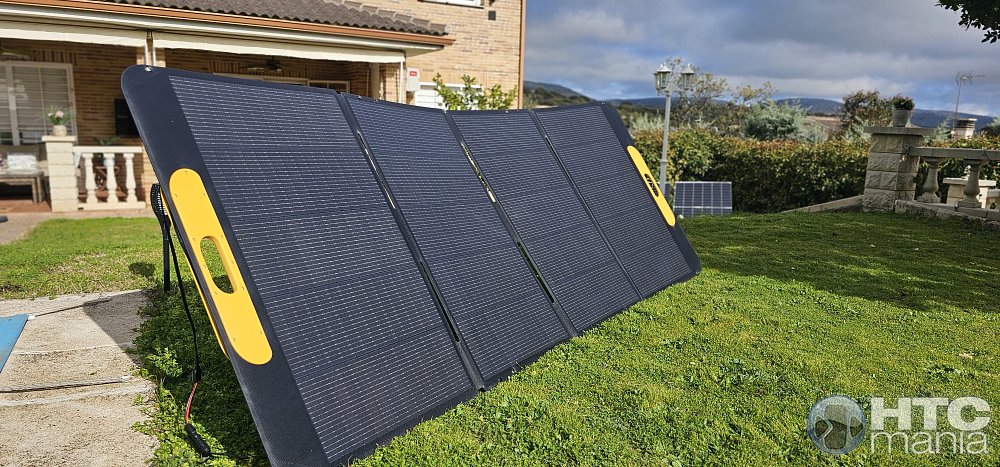 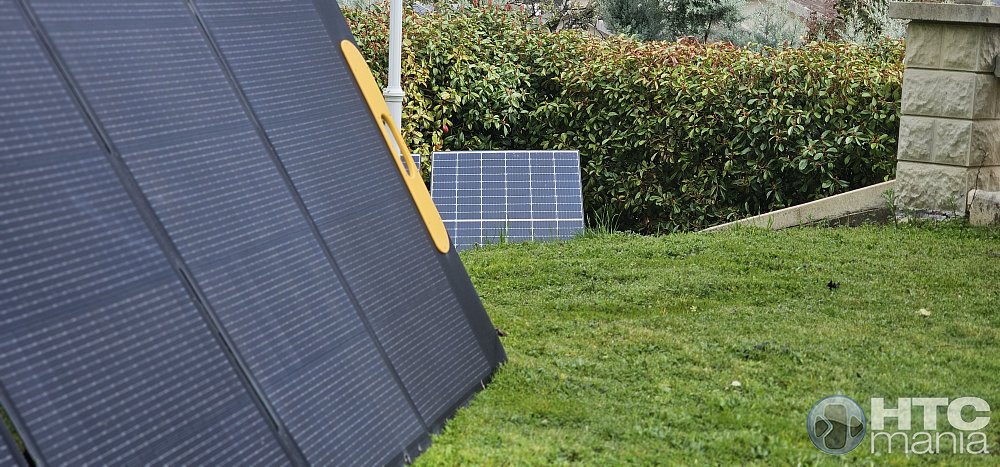 Despite being slightly less powerful than the fixed 450W ones, their efficiency is amazing. They manage to saturate the battery input as soon as the sky clears a bit, which proves the quality of their monocrystalline cells. 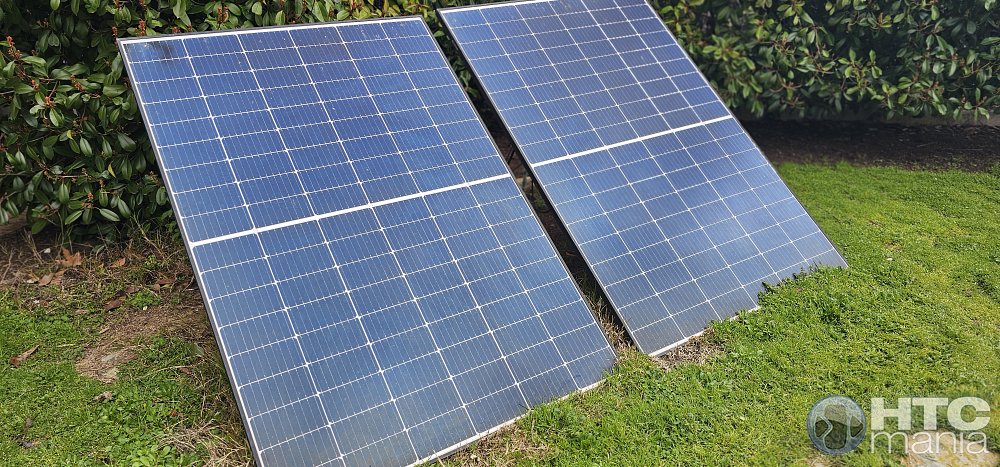 Having this performance under the sun turns the combination of the Jump 2200 with the 400W panel into a true portable power plant. It's not common for a station in this segment to take such good advantage of every ray of light even when conditions are not perfect. The fact that the system stabilizes at the battery's maximum input gives us the peace of mind that we are making the most of every cent invested in the solar equipment. 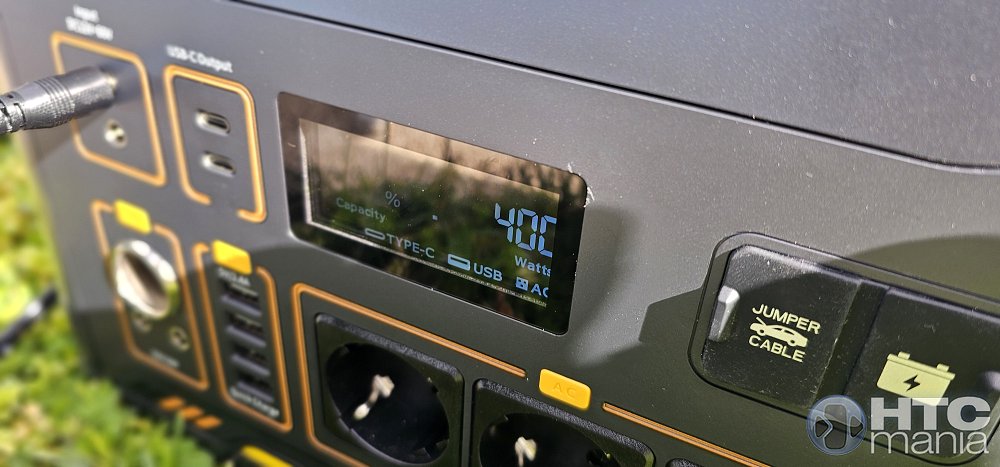 One aspect you must take into account when using the VTOMAN is the behavior of its active cooling system. When the station has been receiving 400W from the solar panel or over 313W from the wall charger for a while, the generated heat forces the fans to work intensely. The sound it emits is loud and forceful. If we are outside on a route or in a garden, the noise goes completely unnoticed due to ambient sound. However, if you intend to use it inside a house in a quiet area, you will notice that the fan becomes very present and can be somewhat annoying. You can see it in this short video. Realistically, it must be understood that this device was not designed to serve as a domestic UPS that is always connected in a corner of the living room. Although it is capable of switching in less than 20 milliseconds in case of a blackout, its true calling is to be a tool for occasional and adventurous use. Its 17.5 kg weight and reinforced structure speak of equipment for heavy use in the field or to have in the garage as energy support. In those contexts, the power of its ventilation is a guarantee that the cells are always kept at a safe temperature to prolong their lifespan. Before starting to test the station, let's briefly talk about its specs. The heart of the unit is its 1548Wh battery made with lithium iron phosphate cells known as LiFePO4. Additionally, the integrated pure sine wave inverter is capable of delivering a constant power of 2200W with peaks of up to 4400W to start motors or heavy tools without problems.  Delving into cell technology is essential to understand why the VTOMAN Jump 2200 is a smart long-term investment. The equipment uses lithium iron phosphate batteries, better known as LiFePO4, which are the current gold standard for safety and durability. Unlike conventional lithium batteries, these cells offer much higher thermal stability, which drastically reduces the risk of overheating or fire even under intense use. The manufacturer guarantees more than 3000 charge cycles before the capacity drops to 80%, which translates to about ten years of daily use without noticing significant degradation. Additionally, the unit incorporates the LIFEBMS system, which is an advanced electronic management that protects each cell individually against overcharges or deep discharges to ensure they always work in their optimal range. Regarding the UPS or uninterruptible power supply function, this model offers professional-level protection for your most delicate equipment. The operation is very simple, as you only have to connect the station to the electrical network and your devices to the sockets on the battery itself. While there is light at home, the energy passes directly from the wall to your devices and at the same time keeps the battery charged. The truly impressive thing happens when there is a blackout, as the system is capable of switching to battery mode in less than 20 milliseconds. This speed is so high that critical devices like a desktop computer or a router do not turn off or restart, allowing you to continue working or playing without noticing the power cut. It is important to note that this UPS function is not only useful for leisure but can be vital for medical equipment such as respirators or sleep apnea machines. During the tests, we were able to verify with a high-power light bulb how, when cutting the mains supply, the light does not even flicker, demonstrating the effectiveness of the pure sine wave inverter. Having this capability in a portable 2200W station gives you enormous peace of mind both at home and on the move. It is a feature usually reserved for much more expensive fixed equipment and here it comes integrated as standard to protect us against any electrical grid instability. Let's go with the real-world usage tests. Taking the equipment to the mountains is the ultimate scenario to check if a power station is a toy or a real tool.  For this outdoor "torture" session, we decided to connect a 3D printer and a heater, two devices that represent opposite worlds in terms of electrical consumption. 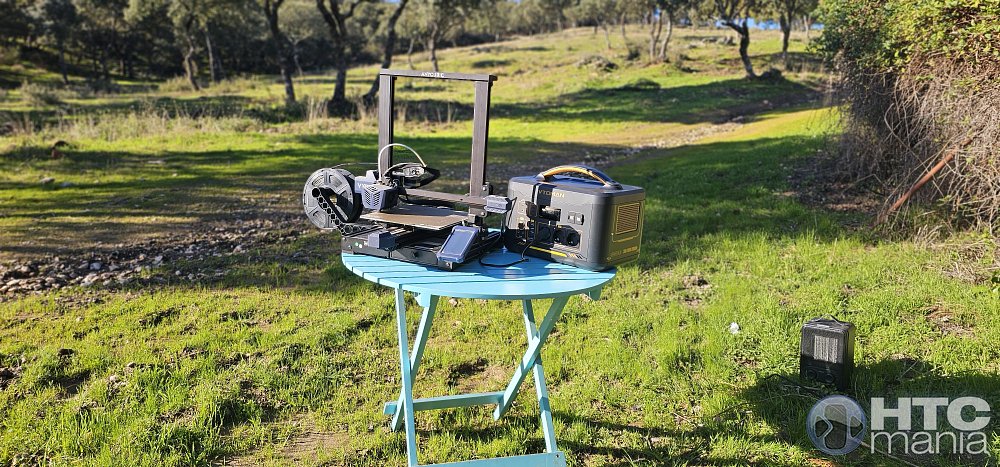 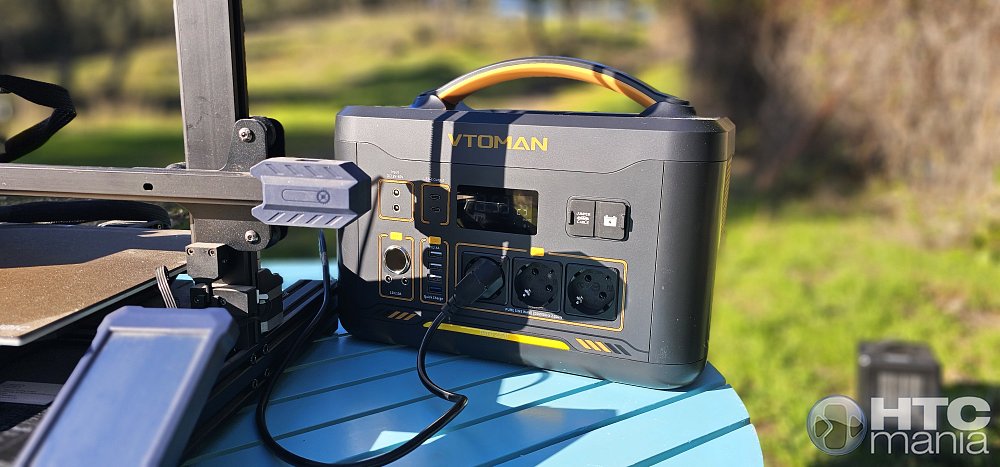 The printer is a precision device that requires a very stable power supply and consumes an average of about 500W, although it has higher peaks during the critical heating phase of the bed and the extruder. Thanks to the pure sine wave inverter of the VTOMAN Jump 2200, the printer's electronics have worked with astonishing smoothness, without strange noises in the motors or leveling errors, which shows that the current quality is identical to what we have in any wall socket at home.   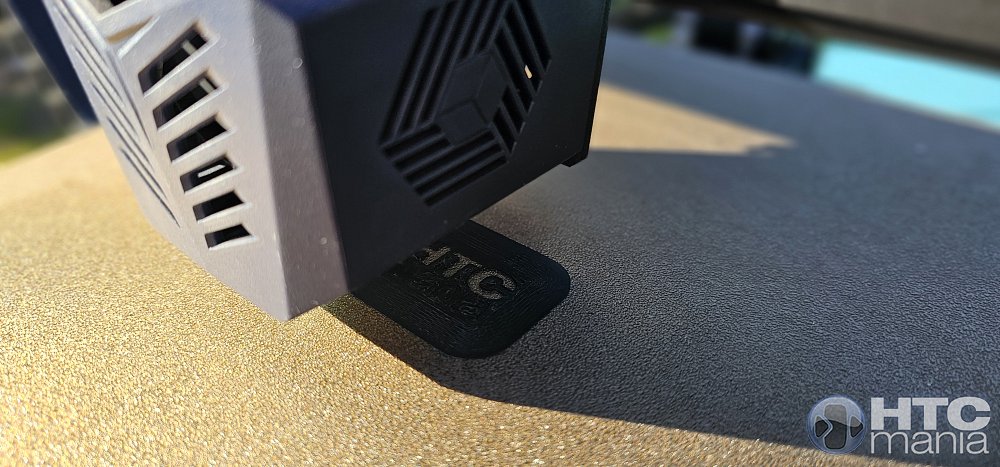 The real challenge arrived when turning on the heater at maximum power, a device that devours about 1500W to generate heat immediately. By combining both devices, we reached a total consumption that hovered around 2200W constant, a figure that would put many competing stations in trouble. The Jump 2200 managed this load without breaking a sweat, even exceeding its safety margin of 2200W nominal output (it allows peaks up to 4400W). Seeing on the front screen how the system delivered such an amount of energy while we were in the middle of nowhere is an incredible feeling of freedom. The printer finishes its task in barely 30 minutes.   With this result. 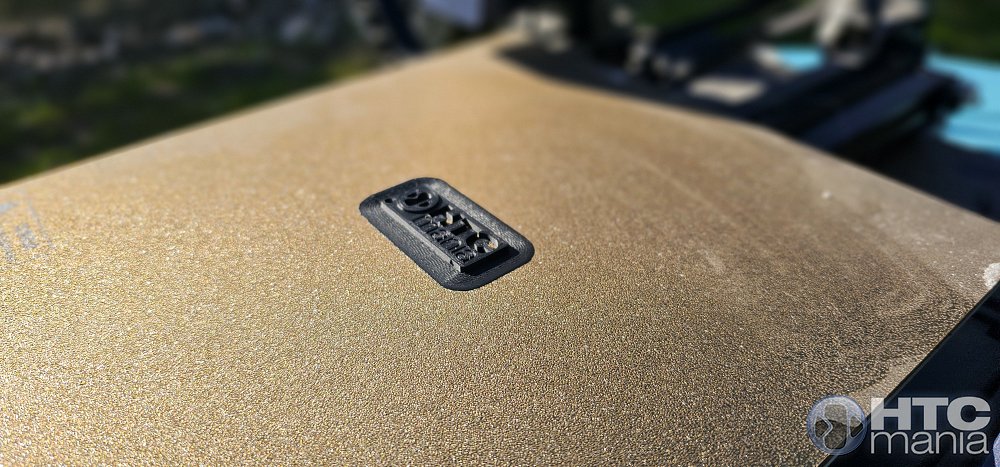 This experience in the mountains confirms that we are not looking at a simple accumulator for charging mobiles or light bulbs, but at a true portable power station capable of running heavy machinery and sensitive electronics simultaneously. The robustness of the chassis and the stability of the rubber feet were key to keeping the unit firm on the uneven terrain of the field while we worked. Being able to finish a complex 3D print while keeping the outdoor work area warm is the definitive proof that this VTOMAN combo is on another level of reliability. Another trial by fire we performed was with a ceiling radiator, testing its three power levels from 750W up to 2000W of direct consumption. The result was impeccable, confirming that the VTOMAN Jump 2200 handles these resistive loads with total stability without showing signs of fatigue in its pure sine wave inverter. The fans, as expected, worked at full throttle to cool the internal components, but performance did not drop at any time during the test. In conclusion, it is clear that the ecosystem formed by the VTOMAN Jump 2200 and its 400W panel is a high-performance power solution that prioritizes reliability over unnecessary frills. This set is specifically designed for three very clear user profiles looking for total electrical independence without technical complications. The first group is lovers of camper life and overlanding who need to power compressor fridges or kitchen tools and who, thanks to the solar panel, can stay disconnected from the grid indefinitely. The second profile is the professional or DIY enthusiast who needs to take their workshop outdoors, as we have seen with the 3D printer or the use of powerful heaters in the middle of the mountains. Lastly, it is an excellent tool for those seeking energy life insurance at home thanks to its ultra-fast UPS function that protects critical equipment against any unexpected blackout. What stands out most about this product is its technical honesty, as it delivers exactly what it promises on the box without fine print. Having a 2200W pure sine wave inverter with 4400W peaks gives you the freedom to connect anything from a delicate laptop to a ceiling radiator without fear of damaging anything. The safety provided by LiFePO4 cells with over 3000 life cycles is a weighty argument for those who see this equipment as a ten-year investment. Additionally, the VS400 solar panel has proven to be an efficiency beast, being able to saturate the battery input even in diffuse light conditions, which greatly facilitates energy management on long routes. As points to keep in mind for future buyers, we must remember that the fan noise is forceful when we demand maximum effort, which reinforces its identity as a field tool rather than a living room appliance. The weight of 17.5 kg is the price to pay for a real capacity of 1548Wh and such robust construction. If you are looking for a station that withstands tough treatment and offers one of the best ratios between watts and durability on the market, this VTOMAN combo is a winning bet that won't let you down. You have much more info on the manufacturer's official website, for both the station and the panel.
|
|
|
|
 Estás aquí
|
||||||
|
||||||


![Array
[xs_avatar]](https://avatar.htcmania.com/avatares/avatar1638141_1.gif)


